Broker exports in.
Capital Gains worked out.
HMRC's matching order applied in full, Section 104 pools with their whole history shown, the tax actually due, SA108 figures, and a computation pack your accountant will nod at.
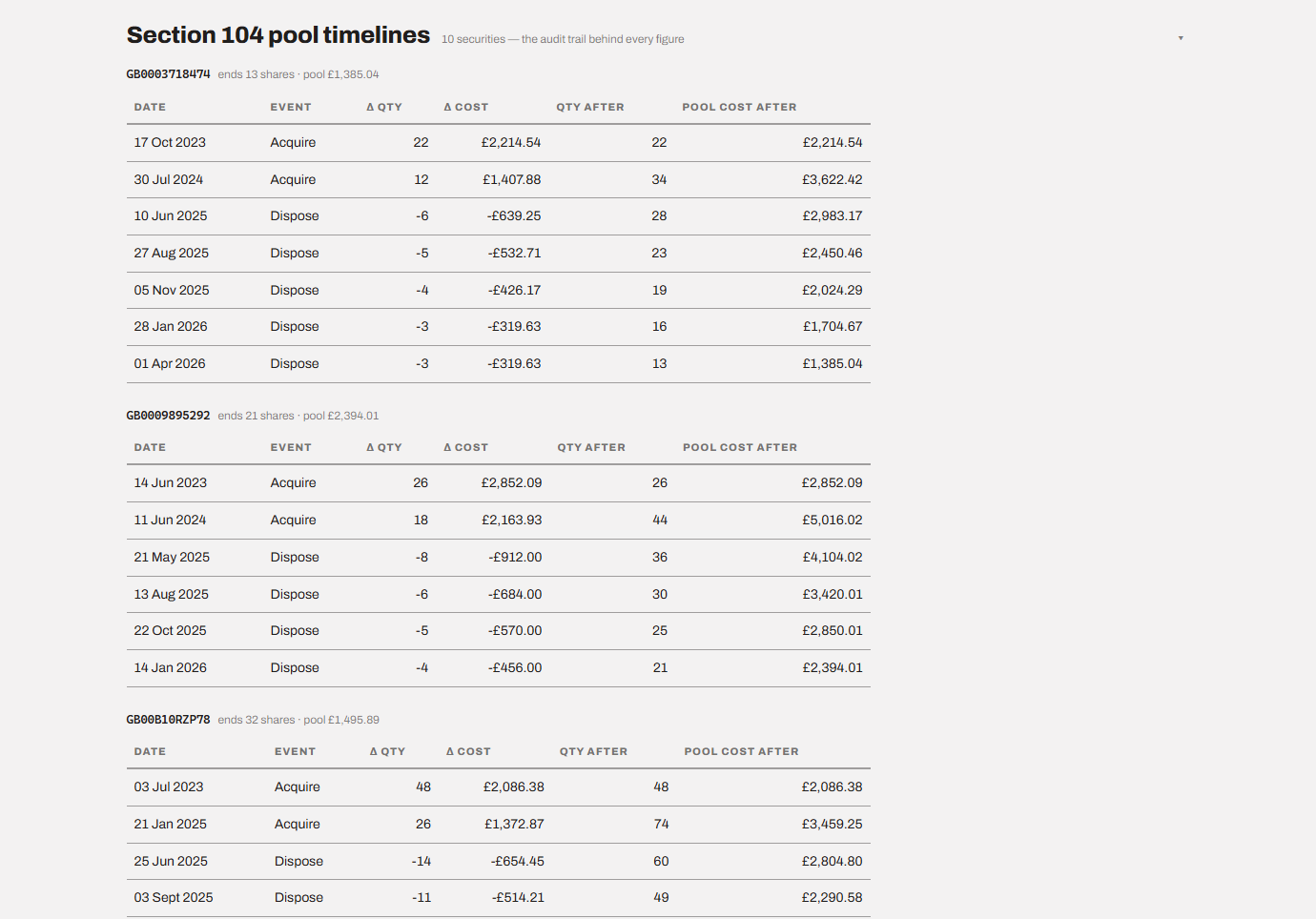
Section 104 pool timeline — running quantity and cost after every event
What you end up with
SA108 figures
The boxes as they appear on the Capital Gains summary, ready to copy onto your return.
Computation pack
Every matched slice and pool movement behind each figure, as PDF and CSV.
Disposals CSV
The full disposal list, for your own records or your accountant's software.
Encrypted session
Your normalised transactions saved locally, so next year you reload instead of re-importing.
Profiles marked beta work, but have not yet been validated against a real customer export.
Broker not listed? The column-mapping wizard walks through an unrecognised CSV once and saves it as a new platform.
Reads real broker exports
Trading 212 first-class; Freetrade, Hargreaves Lansdown, AJ Bell, interactive investor, Vanguard UK, DEGIRO, Interactive Brokers and Coinbase via built-in profiles; anything else through a column-mapping wizard that can save itself as a new platform.
Applies the rules, not an approximation
Same-day, then bed-and-breakfast (30-day), then the Section 104 average-cost pool. Money is decimal throughout — never floating point.
Knows what's exempt
ISA and SIPP exports are recognised and excluded from CGT rather than silently pooled with taxable accounts.
Handles the awkward parts
Foreign-currency-priced but GBP-settled trades, manual adjustments, the 30 October 2024 rate change, and the capital-loss ledger with its four-year claim deadline.
Looks forward, not just back
Remaining Annual Exempt Amount headroom, unrealised gains, and 30-day-rule warnings before you sell.
Saves your work
Sessions persist the normalised transaction stream encrypted at rest, so you reload instead of re-importing.
A
Same day
Disposals match acquisitions made on the same date first.
B
Next 30 days
Then acquisitions in the following thirty days — the bed-and-breakfast rule.
C
Section 104 pool
Whatever remains comes from the average-cost pool, with its history shown.
Covered
- UK-resident individuals
- Listed shares, funds, supported crypto
- Taxable accounts, with ISA/SIPP excluded
- 2020/21 – 2025/26 filing, 2026/27 planning
Not covered
- Property, trusts and companies
- Non-resident computations
- Sophisticated reliefs
- Filing to HMRC on your behalf
Test it against your real exports.
We're looking for people who file their own Capital Gains and will run an early build alongside their existing calculation.
Opens your email app, addressed to us. No list, no newsletter. A person replies.